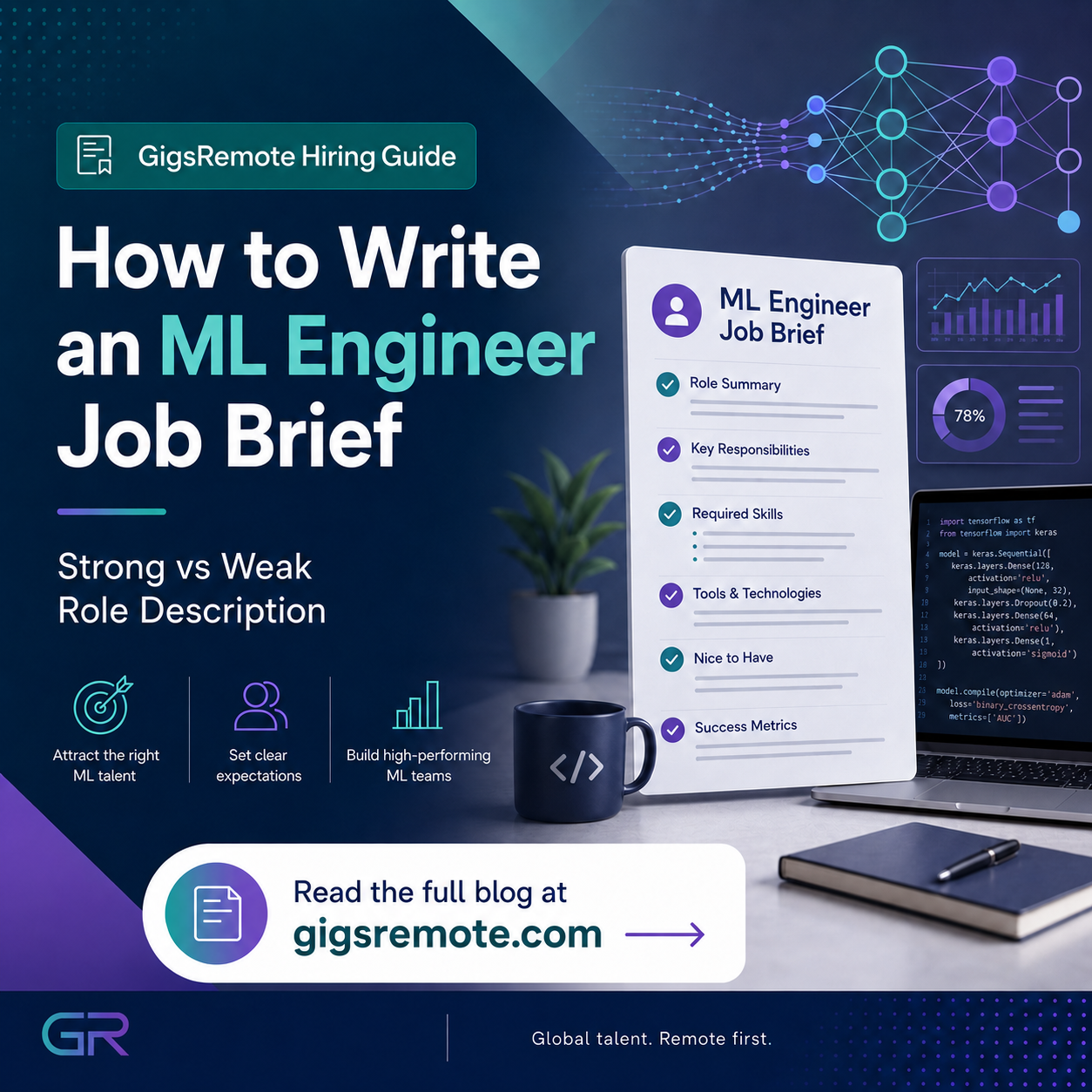
How to Write a Great AI Engineer Job Brief
A clear brief helps the right AI Engineer understand the problem, scope, responsibilities, and expected outcome before the interview begins.
“AI Engineer” can describe very different profiles, from generative AI and machine-learning engineering to MLOps, computer vision, forecasting, and AI product development.
That is why a strong brief should do more than list technologies. It should explain the business problem, the current project stage, the required level of ownership, and the result you need.
The clearer the brief, the easier it is for experienced AI Engineers to judge whether their skills and previous projects are relevant.
1. Define the Role Clearly
Start by specifying the type of AI work involved.
Choose the Role Focus
- Generative AI and large language models
- Machine-learning engineering
- AI product development
- Data and model pipelines
- MLOps and deployment
- Computer vision
- Recommendation or forecasting systems
List Relevant Technologies
Include only the technologies that are directly connected to the work.
We need a Senior AI Engineer with Python, LLM integration, retrieval-augmented generation, API development, and AWS deployment experience.
2. Start With the Business Problem
Do not open with a long list of tools. Explain the challenge first.
What is the current problem?
Describe what is not working today or which opportunity the company wants to capture.
Who is affected?
Identify the customers, employees, or teams experiencing the problem.
Why does it matter?
Explain the commercial, operational, or product impact.
What does success look like?
Define the result the engineer should help create.
3. Explain the Current Project Stage
Candidates need to understand what already exists before they can assess the scope.
- An early idea or defined use case
- Available and prepared data
- A working prototype
- An existing model
- Cloud infrastructure
- An internal data or engineering team
We have an early prototype built with Python and the OpenAI API. The engineer will improve retrieval quality, introduce model evaluation, and prepare the solution for production.
4. Define Responsibilities and Deliverables
Explain what the AI Engineer will own and what they are expected to produce.
Possible Responsibilities
- Recommend the technical approach
- Prepare and transform data
- Develop or integrate models
- Build APIs
- Deploy the solution
- Document technical decisions
Possible Deliverables
- A working proof of concept
- A production-ready AI feature
- An evaluated model
- A data pipeline
- Technical documentation
- Knowledge-transfer sessions
Where possible, add measurable expectations such as an eight-week launch target, an agreed accuracy threshold, or a reduction in manual processing time.
5. Separate Essential Skills From Preferences
Avoid asking one person to be an expert in every area of AI.
Essential Skills
- Python
- Machine-learning or LLM development
- Data preparation
- Model evaluation
- API integration
- Cloud deployment
- Production software engineering
Desirable Skills
- Experience in your industry
- Familiarity with your preferred cloud provider
- Knowledge of a specific vector database
- Previous startup or consulting experience
6. Include the Engagement Details
Strong candidates need practical information before deciding whether to apply.
Include:
- Contractor or permanent position
- Full-time, part-time, or custom workload
- Expected start date
- Project duration
- Time-zone coverage
- Remote-working expectations
- Rate or salary range
- Key milestones
This is a three-month, full-time remote contract with possible extension. The engineer must provide at least four hours of overlap with UK working time and should be available to begin within two weeks.
7. Describe the Team and Working Style
AI delivery is rarely an isolated activity. Explain:
- Who the engineer will work with
- Who owns product decisions
- Whether the role is hands-on or leadership-focused
- How often the team meets
- Which collaboration tools are used
- Whether mentoring is expected
8. Contractor or Full-Time?
Choose a Contractor When
The requirement is urgent, specialist, experimental, time-limited, or based around a defined deliverable.
Typical projects include proofs of concept, AI architecture audits, data pipelines, and specific AI product features.
Choose Full-Time When
AI is central to the long-term product strategy and requires continuous internal ownership.
A permanent role is more suitable when the workload is predictable, ongoing, and part of a wider internal AI capability.
Final Takeaway
A great AI Engineer job brief does not need to be long.
It needs to make the problem, scope, technical expectations, working model, and desired result clear.
Clear brief. Better matches. Stronger outcomes.

.png)