
Artificial intelligence is becoming a priority for businesses across almost every industry. From intelligent customer support to predictive analytics and automated decision-making, the opportunities are significant.
But while businesses are often eager to invest in AI tools, there is one fundamental question that can get overlooked.
Is the data actually ready to support them?
An AI model might be powerful, but its effectiveness depends heavily on the information it can access, interpret and use. If that information is incomplete, inconsistent or scattered across disconnected systems, even the most sophisticated AI solution can struggle to deliver meaningful value.
For many organisations, the first step towards successful AI adoption isn't building an AI feature. It's getting the data foundations right.
The Hidden Challenge Behind AI Implementation
When businesses begin exploring AI, the conversation often centres on models, capabilities and potential use cases.
Can we build an AI-powered assistant? Could we automate customer enquiries? Can we use predictive analytics to improve decision-making?
These are valuable questions. But they assume that the underlying information is already accessible, reliable and usable.
In practice, businesses frequently encounter problems such as:
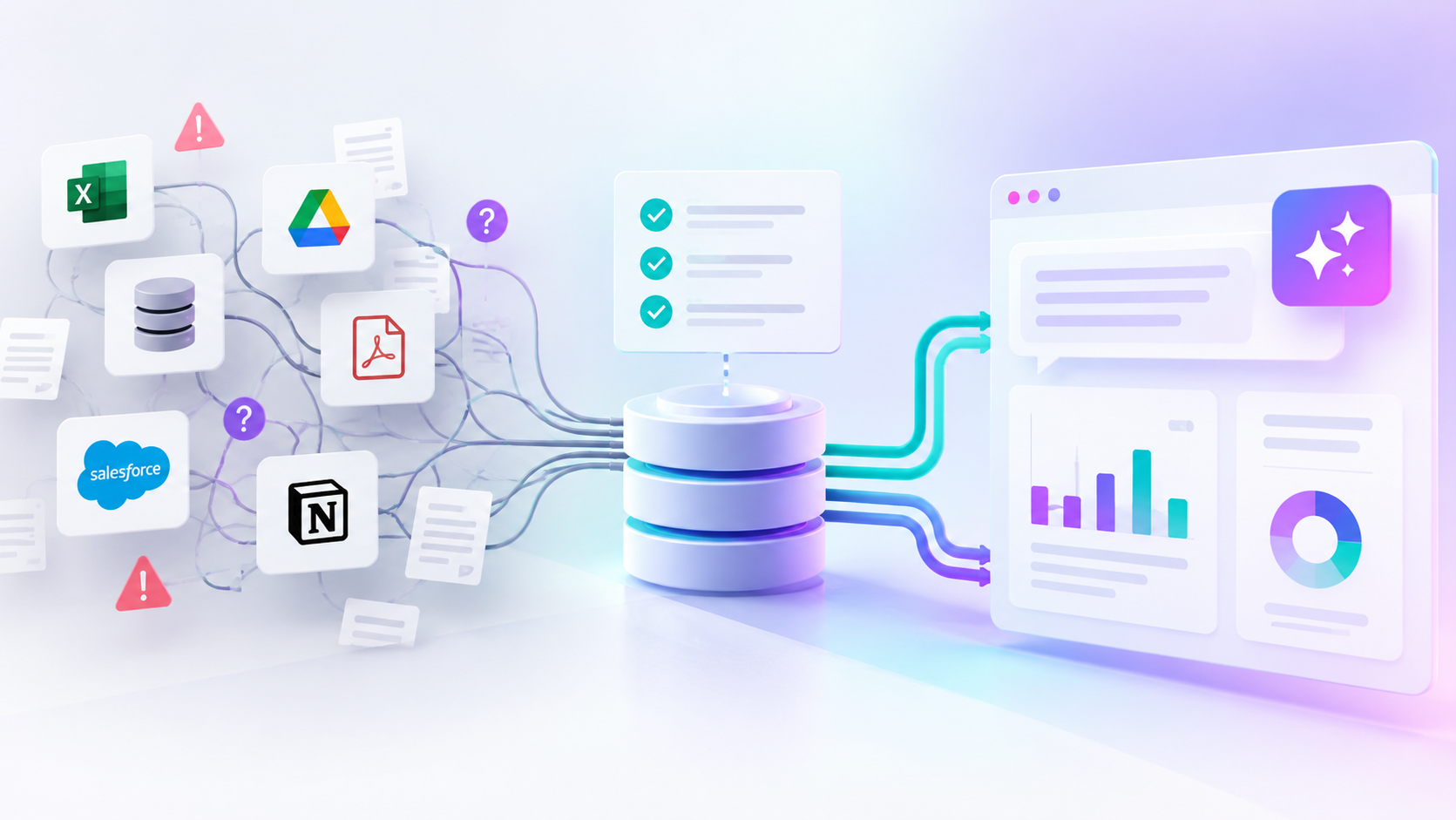
- Fragmented data: Important information is spread across spreadsheets, databases and disconnected platforms.
- Inconsistent quality: Records contain missing fields, outdated information, duplicates or conflicting formats.
- Unclear ownership: Nobody has clear responsibility for maintaining data accuracy or controlling access.
- Unreliable pipelines: Information isn't consistently updated or transferred between systems.
- Limited accessibility: Valuable data exists, but the systems that need it cannot easily retrieve it.
Individually, these issues might seem manageable. Together, they can become significant barriers to AI implementation.
Why Better AI Models Won't Fix Poor Data
It's tempting to assume that a more advanced AI model will compensate for weaknesses in the underlying information.
Unfortunately, that's rarely a reliable solution.
Consider a business developing an AI assistant to answer customer questions about orders, deliveries and account information.
The assistant might be excellent at understanding natural language. But if customer records are outdated, delivery information is stored in a separate system and product availability isn't updated consistently, its responses may still be inaccurate.
The problem isn't necessarily the AI. It's the information the AI depends on.
The same applies to predictive analytics. A model designed to forecast demand will struggle if historical sales records are incomplete or inconsistent.
Improving the model cannot automatically resolve missing information, unclear definitions or unreliable data sources.
In many cases, improving data quality and accessibility creates more immediate value than investing in additional AI capabilities.
Four Questions to Ask Before Starting an AI Project
Before committing to AI development, businesses should assess four practical areas of data readiness.
1. Can We Access the Right Data?
Having data and being able to use it are two different things.
Information might exist across multiple platforms, but integrating it into an AI system can be difficult, particularly when systems lack suitable interfaces or impose access restrictions.
Businesses should identify which information the proposed AI feature actually needs and whether it can be accessed securely and consistently.
2. Can We Trust Its Quality?
AI systems depend on accurate and relevant inputs.
Duplicate customer records, inconsistent terminology and outdated information can undermine performance before a model has even been deployed.
The objective isn't necessarily perfect data. It's ensuring that the information is sufficiently reliable for the intended use case.
A customer-facing AI assistant, for example, may require much stricter accuracy standards than an internal tool used to explore preliminary ideas.
3. Who Owns the Data?
Data ownership is not simply an administrative concern.
Businesses need clarity over who is responsible for maintaining information, approving access and resolving inconsistencies.
Without clear accountability, data problems can persist even after technical improvements have been made.
Ownership also matters for security, privacy and compliance, particularly when AI systems interact with sensitive business or customer information.
4. Will the Data Stay Reliable?
Preparing a dataset for an initial demonstration is one thing. Keeping it accurate in a live business environment is another.
If an AI application relies on regularly changing information, it needs dependable processes for receiving updates and handling errors.
Otherwise, a promising prototype can quickly become an unreliable production system.
Data readiness is not a one-off task. It needs to be maintained throughout the AI system's lifecycle.
When Should a Business Prioritise Data Before AI?
Not every AI project requires a complete overhaul of an organisation's data infrastructure.
A relatively simple AI feature using a small, well-maintained knowledge base may be straightforward to implement.
However, a data-first approach becomes particularly important when the proposed solution depends on multiple systems, frequently changing information or business-critical decisions.
For example, a company hoping to introduce AI-powered sales forecasting might discover that different departments use inconsistent definitions of revenue, customer activity or pipeline stages.
Before building a predictive model, aligning those definitions may be the most valuable investment.
Similarly, an organisation developing an internal AI knowledge assistant may find that its biggest challenge isn't selecting a model, but organising documents, managing permissions and ensuring employees can access the latest information.
In both cases, addressing the data problem creates the conditions for AI to deliver value.
Start Small, But Start With the Foundations
A data-first approach doesn't mean businesses need to spend months rebuilding every internal system before experimenting with AI.
Instead, the most effective approach is often to start with a specific business problem and work backwards.
Identify the desired outcome, determine what information is required and assess whether the existing data can support it.
If gaps emerge, prioritise the improvements that directly affect the use case.
This might involve consolidating a few important datasets, improving access to an existing platform, introducing clearer ownership or establishing a more reliable update process.
By focusing on the data that matters most, businesses can avoid unnecessary infrastructure projects while still building a stronger foundation for AI.
The Real Starting Point for AI Success
AI adoption is often presented as a technology challenge. In reality, successful implementation depends just as much on the systems, processes and information supporting that technology.
A sophisticated model cannot consistently deliver useful outcomes if the information behind it is unreliable.
For businesses exploring AI, the smartest investment may therefore come before the model is built.
At GigsRemote, we understand that delivering successful technology projects often requires more than one area of expertise. Whether the challenge involves improving data foundations, integrating existing systems or developing AI capabilities, identifying the right technical needs from the outset is essential.
Before asking what AI can do for your business, ask whether your data is ready to make it possible.