When businesses budget for an AI project, the first consideration is often the cost of hiring technical talent. How much will an AI engineer charge? What is the daily rate of a machine learning specialist? Could a cheaper contractor deliver the same solution?
While these are important questions, they only reveal part of the picture.
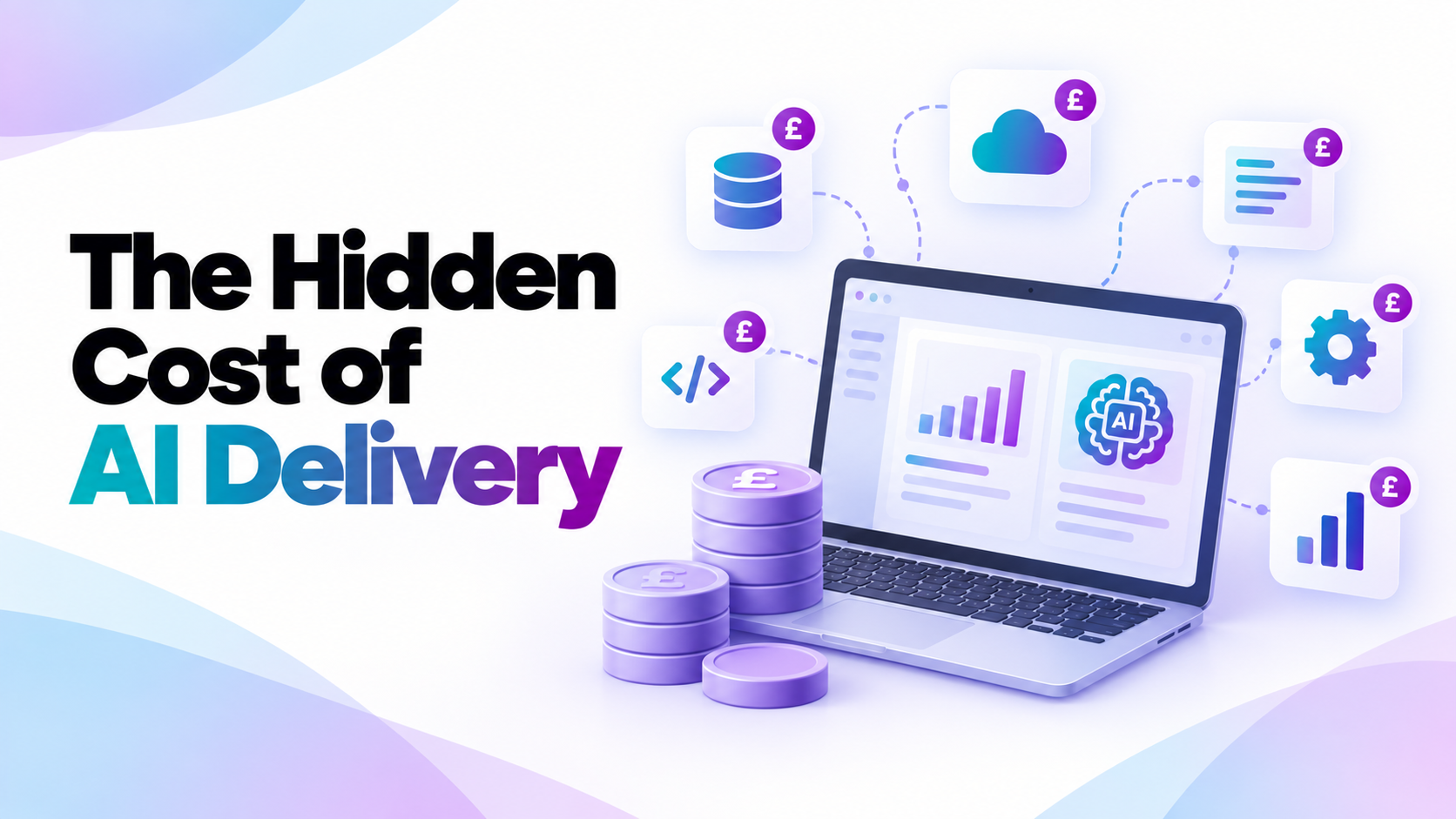
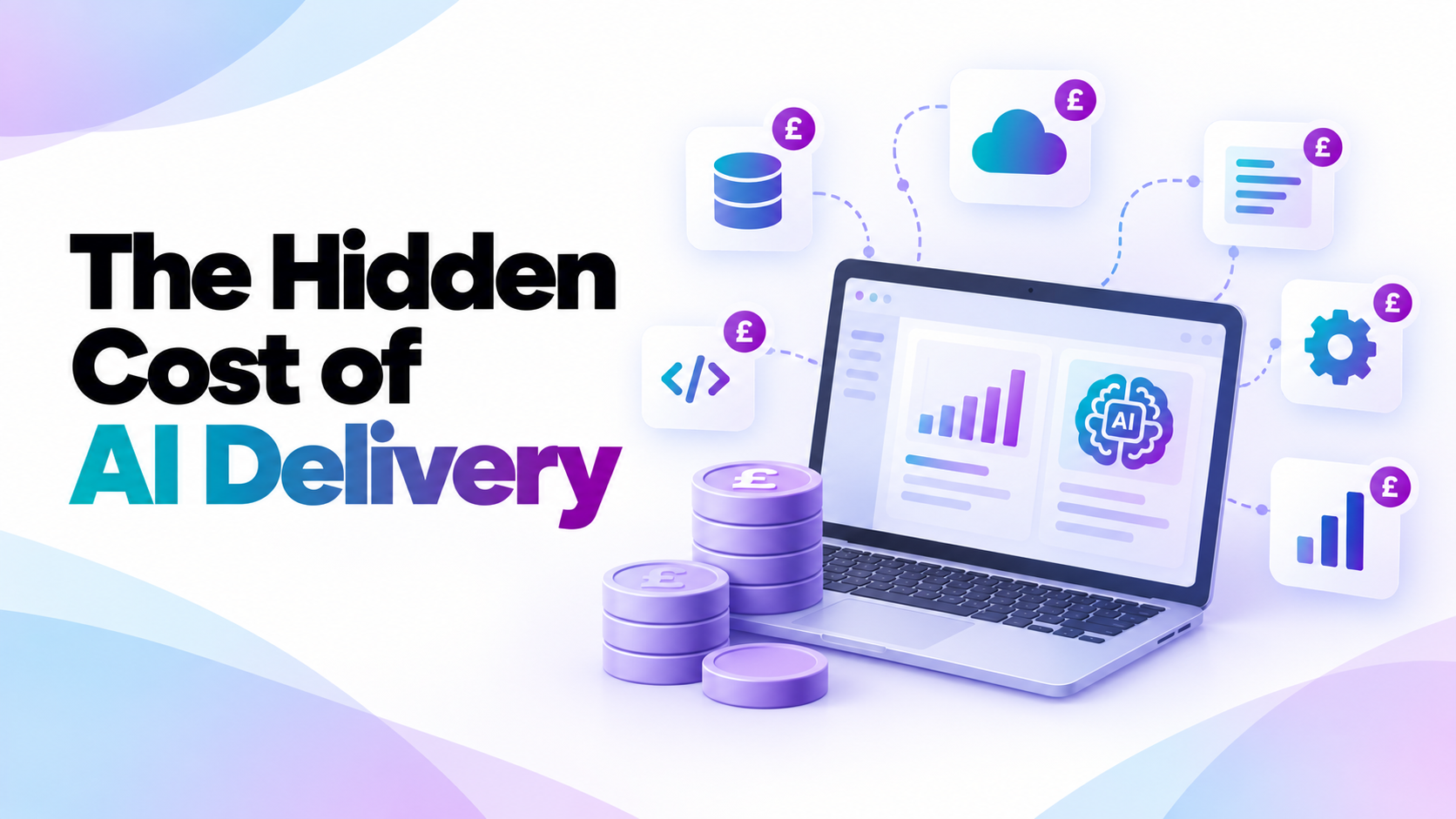
The true cost of AI delivery extends far beyond the people building it. Model usage, computing infrastructure, system integration, performance optimisation and ongoing maintenance all contribute to the final investment.
For businesses looking to make AI commercially viable, understanding these hidden costs is essential.
Why Contractor Rates Don't Tell the Full Story
It's easy to compare contractors based on their hourly or daily rates. However, a lower rate doesn't necessarily translate into a lower project cost.
Consider two AI specialists working on the same project. One charges a higher rate but has extensive experience designing efficient AI systems. The other offers a lower rate but requires additional time to resolve technical challenges, redesign components or troubleshoot integrations.
The second option might appear cheaper initially, but the overall delivery cost could be considerably higher.
This is where Total Cost of Delivery (TCoD) becomes important.
Rather than focusing exclusively on the cost of individual resources, TCoD considers the full investment required to develop, deploy and maintain a working solution.
And when it comes to AI, several expenses can easily be overlooked.
7 Hidden Costs of AI Delivery
1. Model Usage and API Costs
Many AI applications rely on external models accessed through APIs, where businesses pay according to usage.
Costs can depend on the number of requests, the amount of information processed and the model selected.
An AI assistant might be inexpensive during testing, but once deployed across thousands of daily interactions, usage costs can grow significantly.
Choosing the right model for each task, limiting unnecessary requests and optimising how information is processed can make a substantial difference.
2. Computing Infrastructure
AI applications need infrastructure to run, whether that's cloud hosting, data storage, processing capacity or specialised hardware.
More complex applications, particularly those involving model training or large-scale inference, can require significant computing resources.
However, more computing power doesn't automatically mean better results.
An experienced technical team can help identify an architecture that meets performance requirements without introducing unnecessary infrastructure costs.
3. Latency and Performance
An AI system might generate excellent results, but what happens if users have to wait too long to receive them?
Latency, or the time it takes a system to respond, can directly affect productivity and user experience.
Reducing latency may require faster models, additional computing capacity or architectural improvements, all of which can influence costs.
Businesses therefore need to balance response quality, speed and operational efficiency rather than optimising for accuracy alone.
4. Rework and Technical Debt
One of the most overlooked AI delivery costs is the time spent correcting decisions made earlier in development.
Poorly defined requirements, unsuitable models, weak data foundations or unnecessarily complex architecture can all lead to rework.
For example, a business might begin developing a custom AI solution before discovering that an existing service could have delivered the required functionality.
The result? Additional development time, wasted resources and delayed deployment.
Getting the technical approach right early can be more valuable than simply reducing development costs.
5. Integration with Existing Systems
AI rarely operates in isolation.
A business might want an AI assistant to access customer records, retrieve internal documents, update a CRM or communicate with existing software.
Making these connections reliable and secure requires integration work, data preparation, authentication and testing.
In some projects, integrating AI into existing business workflows can be more demanding than implementing the AI model itself.
This is why integration requirements should be assessed before development begins, rather than treated as an afterthought.
6. Monitoring and Evaluation
Launching an AI application is only the beginning.
Businesses need to monitor how their systems perform, whether outputs remain accurate and whether costs are increasing unexpectedly.
This can involve tracking model performance, response times, usage patterns, errors and user feedback.
Without effective monitoring, businesses risk continuing to pay for systems that aren't delivering the expected value.
Evaluation also helps identify opportunities to improve performance and reduce unnecessary spending over time.
7. Ongoing Maintenance and Operational Support
Unlike a one-off development task, an AI application typically requires ongoing attention.
Models may need updating, integrations can break, security requirements evolve and business needs change.
Operational support might include troubleshooting, updating data pipelines, adjusting prompts, improving model performance and responding to unexpected behaviour.
These costs should be considered from the outset, particularly for AI systems intended to become part of everyday business operations.
The Difference Between Cheap Development and Cost-Effective Delivery
Imagine two businesses developing similar AI-powered customer support systems.
Business A prioritises the lowest possible development budget. It selects a cheaper contractor and begins building immediately, with limited time spent assessing existing systems or long-term operating costs.
The initial implementation works, but the business later discovers that its model is unnecessarily expensive, its integrations require significant maintenance and its architecture struggles with increased usage.
Business B invests more time upfront in technical planning. Its specialists assess the available data, select an appropriate model, design efficient integrations and establish monitoring processes.
Business B might spend more during the initial development phase, but its solution could prove considerably more cost-effective over time.
The difference is not necessarily the amount spent on talent. It's how effectively that expertise translates into a reliable, maintainable solution.
How Businesses Can Reduce Their Total Cost of AI Delivery
Managing AI costs doesn't mean choosing the cheapest possible technology or reducing investment in specialist expertise.
It means making better decisions throughout the project lifecycle.
Businesses can improve cost efficiency by:
- Defining clear business outcomes: Understand what the AI system needs to achieve before deciding how to build it.
- Choosing the simplest effective solution: Not every use case requires a custom model, complex AI agent or expensive infrastructure.
- Assessing data and integration requirements early: Identify potential technical blockers before they become costly development problems.
- Testing before scaling: Validate model performance, reliability and operating costs using realistic scenarios.
- Monitoring ongoing expenditure: Track usage, infrastructure costs and performance to identify opportunities for optimisation.
- Bringing in the right expertise: Experienced specialists can help avoid unnecessary complexity and make better architectural decisions from the beginning.
The objective is not simply to minimise spending. It's to ensure that every investment contributes towards a useful business outcome.
Why the Right Technical Talent Matters
Technical talent is often viewed as one of the largest expenses in AI development. But experienced specialists can also play a significant role in controlling the wider cost of delivery.
A senior AI engineer might recognise that a smaller model is sufficient for a particular task. A data engineer could identify quality issues before they disrupt development. An experienced backend specialist might design integrations that are easier to maintain and scale.
These decisions can reduce unnecessary work, improve efficiency and prevent expensive problems further down the line.
At GigsRemote, we believe businesses should evaluate technical talent based on the value and outcomes they help deliver, rather than focusing solely on hourly or daily rates.
By connecting organisations with experienced technology contractors, GigsRemote helps businesses access the specialist expertise needed to approach complex projects more effectively.
Whether that's AI engineering, data infrastructure, system integration or technical architecture, the right expertise at the right stage can make a meaningful difference to the overall cost and success of delivery.
The Bottom Line
The cost of AI isn't just what you pay to build it.
Model usage, computing infrastructure, latency, integration, rework, monitoring and operational support all influence the total investment required to deliver a successful solution.
For businesses, the most important question shouldn't be "How cheaply can we build this?"
It should be "How can we deliver the greatest business value at the most sustainable total cost?"
Because ultimately, successful AI delivery isn't about spending the least. It's about investing wisely in the technology, expertise and processes that produce lasting results.